Broker tools
How to check a TMI reconciliation, line by line
Every year a tenant on a net lease gets a statement that turns twelve months of estimated TMI into the real figure, and usually a bill for the difference. Most tenants pay it. The statement is usually a one-page summary, and the overcharges that tenants and their brokers find in it recur: a gross-up applied to costs that do not vary, a new roof charged in one year, an administration fee on the tax bill. Here is how to check one, line by line, with the Canadian cases behind each point.
Key takeaways
- The statement is a summary; the backup is yours to ask for. Ask for it even without an audit clause [2], and in Ontario a court has implied a duty to deliver tax bills, insurance premiums and management invoices with the annual adjustment [17].
- The same few items cause most overcharges: gross-ups, capital costs, administration fees, the building area your share is divided by, and the tax allocation method [1, 5, 12].
- Each one turns on the lease wording. Courts have refused charges a net lease did not expressly allow [12, 15, 16], and allowed broad wording to cover a $5.5 million restoration [23].
- The clock runs. In Ontario a tenant recovering overpaid TMI is generally limited to the last two years [7, 8]; the objection window in the lease is often shorter [1].
How the year-end statement works
During the year the tenant pays monthly instalments of TMI on the landlord's estimate, because the actual costs are not known until the year ends; afterwards the landlord compares the estimate with the actual costs, bills any shortfall and refunds any excess [1]. Ontario leases commonly set a delivery deadline, for example within 120 days of year end, and a top-up is usually due within 30 days of the statement [4]; in Quebec practice the norm is 90 or 120 days after each year end [3]. Two habits to watch for. Some landlords skip the reconciliation for years while raising the estimate each year, and a tenant can negotiate that the estimate does not rise until the statement arrives [5]. And leases often give the tenant a short window to object: in one lease studied, six months [1].
The seven places overcharges hide
| Item | What goes wrong | What decides it | Source |
|---|---|---|---|
| Gross-up | Costs that do not vary with occupancy (insurance, snow, landscaping) grossed up as if the building were full | Only variable costs should be grossed up; tenants can ask for 95% occupancy, not 100%, and a no-profit clause | [11, 12, 1] |
| Capital costs | A roof or parking lot charged in full in one year, or amortized with interest the lease does not allow | Without wording that allows it, amortization and interest cannot be passed through; amortize over useful life | [12, 2, 5] |
| Administration fee | 15% charged on taxes and insurance, or on top of a separate management fee | Only what the lease expressly allows; the fee is commonly excluded from taxes, insurance and capital | [15, 16, 5] |
| Your share | Large tenants, kiosks or storage taken out of the building area your share is divided by | The denominator is often not stated in the lease: ask for it | [5, 1] |
| Remeasurement | A new BOMA measurement raises your area, and with it base rent and TMI | Cap upward adjustments | [2] |
| Property tax | The allocation method changed from year to year, or an assessment reduction not credited | Discretion to allocate must be exercised reasonably and consistently | [18, 16, 1] |
| Utilities | Shared by area without check meters, so low users pay for high users | Ask for utility bills with the statement | [1] |
Gross-up. A gross-up lets the landlord state variable costs as if the building were fully occupied, so the tenants in a part-empty building do not get a windfall [11]. Without one, a sole tenant in a building 30% vacant would pay 70% of costs it generated entirely [12]. The problem is the reverse: a gross-up applied to fixed costs such as property insurance, landscaping or snow removal [1], which do not fall when space is empty. Blakes advises tenants to limit the gross-up to variable expenses and to 95% occupancy [11], and a practitioner notes it is not expected that a court would permit any gross-up without express wording [12].
Capital costs. Whether a capital item can be charged at all depends on the lease. In RioCan Holdings v. Metro Ontario Real Estate (2012 ONSC 1819), a $431,000 parking-lot rehabilitation was a capital expenditure excluded by the lease, even though the landlord had amortized it over 20 years [6, 13]; in Parsons Precast v. Sbrissa (Ontario, 2012) repaving a lot nearly 20 years old was replacement, not repair, and the tenant did not pay its $14,533 share [13, 14]. In British Columbia, Trenchard v. Westsea Construction (2019 BCSC 1675) went the other way: broad "maintenance, operation and repair" wording that did not separate capital from other costs let the landlord recover a $5.5 million restoration [23]. Where capital costs are allowed, tenants should insist they are amortized over the life of the repair [2], and interest on the unamortized balance needs wording of its own [12].
Administration and management fees. Leases charge administration fees of generally 15% of operating costs, or management fees of generally 4% of gross revenue [12]. A net or "carefree" clause does not by itself allow either: in C.C. Tatham & Associates v. 2057870 Ontario (2011) the court refused fees the lease did not provide for [15, 16], and older Ontario decisions refused an unagreed 15% fee as "an arbitrary surcharge" [12]. Where both are charged, a 15% administration fee on top of management fees is a "double dip", and the fee should not apply to insurance, taxes, capital costs or depreciation [5]. A BC appeal court enforced both where the lease expressly allowed both [12].
Property tax. Taxes are typically shared by rentable area, so the landlord carries the share on vacant space [21]. In 100 Bloor Street West v. Barry's Bootcamp (2025 ONCA 447) the Court of Appeal held that a discretion to allocate taxes must be exercised reasonably [18], and in OGT Holdings v. Startek (Ontario, 2009) a landlord that had used one method for years could not switch retroactively [16]. Ask for the assessment notices and tax bills, and check that any assessment reduction reached you [1].
Audit rights, and what to ask for
Treadstone suggests negotiating the right to inspect the records within 12 to 18 months of the statement, with the landlord paying for the audit if it finds overcharging beyond a threshold such as 3 to 5% [4]; a Canadian lease auditor reports look-back windows of 12 to 36 months [20]. Without an audit right a tenant must settle for what the landlord provides [1], but in Ontario the court in 1877352 Ontario Inc. v. 699147 Ontario Inc. (2016) found it commercially reasonable to imply a term requiring the landlord to deliver, with the annual adjustment, "a copy of all of the documents, such as tax bills, insurance premiums, property management invoices" behind it [17]. A confidentiality agreement answers most landlords' objections [1]. Ask for:
- the property tax bills and assessment notices [17, 1];
- the insurance premiums and the property and period they cover [17];
- property management invoices and service contracts, such as snow removal and landscaping [17, 1];
- utility bills [1];
- the building area and the list of premises excluded from it [5].
How far back you can go
| Province | Rule | Source |
|---|---|---|
| Ontario | Two years from when the tenant ought to have known; in 2026 the Court of Appeal held the period runs from each overpayment, limiting recovery to the two years before the claim. A landlord's claim for rent arrears has six years. | [7, 8] |
| British Columbia | Two years from discovery of the claim. | [9] |
| Alberta | Two years from when the claimant knew or ought to have known, or ten years from when the claim arose, whichever comes first. | [10] |
| Quebec | Three years for a personal right; applying it to overpaid additional rent is our reading, not a source's. | [22] |
The lease can be shorter than the statute: Ontario allows business agreements to vary limitation periods [7], and many leases deem a statement final if the tenant does not object within a set window [1]. Diary both dates when the statement arrives.
A worked example
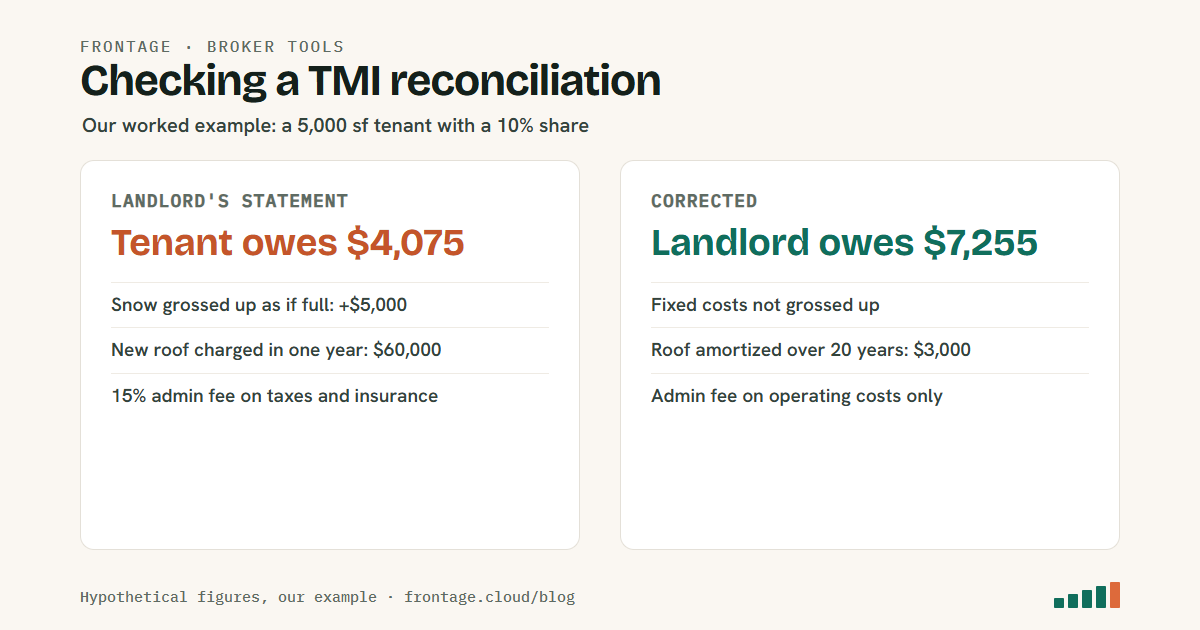
This example is ours, built from the issues above; the figures are hypothetical. The lease allows a gross-up of variable costs to 100% occupancy, a 15% administration fee on operating costs but not on taxes or insurance, and capital items amortized over their useful life without interest. The building is 50,000 square feet and 80% occupied; the tenant has 5,000, a 10% share, and paid $54,000 in estimates.
| Line | As issued | Corrected | Why |
|---|---|---|---|
| Property taxes | 250,000 | 250,000 | |
| Insurance | 30,000 | 30,000 | |
| Repairs and maintenance (incl. a $60,000 roof) | 150,000 | 93,000 | Roof amortized over 20 years: $3,000 a year |
| Janitorial ($40,000 at 80% occupancy) | 50,000 | 50,000 | Variable: gross-up allowed |
| Snow and landscaping ($20,000) | 25,000 | 20,000 | Fixed: no gross-up |
| Administration fee, 15% | 75,750 | 24,450 | On operating costs only, not taxes or insurance |
| Total | 580,750 | 467,450 | |
| Tenant's 10% share | 58,075 | 46,745 | |
| Less estimates paid | 54,000 | 54,000 | |
| Result | Tenant owes 4,075 | Landlord owes 7,255 |
The tenant's share was overstated by $11,330, about 24% above the correct figure, well past a 3 to 5% audit-cost threshold. Whether the roof could be charged at all depends on the lease wording, as RioCan, Parsons Precast and Trenchard show [6, 13, 23]. And if the landlord had taken a 10,000 square foot anchor out of the building area, the tenant's share would rise from 10% to 12.5% before any other line was touched.
The checklist
- Diary the dates: the statement deadline in the lease and the objection or audit window that starts when it arrives [3, 4, 1].
- Ask for the backup, audit clause or not: tax bills, insurance premiums, management invoices, utility bills, service contracts [2, 17].
- Recompute your share: your rentable area, the building area, and which premises are left out of it [5, 1, 2].
- Check the gross-up: is there one, to what occupancy, and on variable costs only [11, 12]?
- Check the administration fee: is it in the lease, on what base, and is it on top of a management fee [15, 5]?
- Find the capital items: roof, paving, HVAC. Excluded, or amortized over their life [6, 13, 2]?
- Check the exclusions: financing, leasing commissions and inducements, costs recovered from insurance or other tenants, head-office salaries [5].
- Check taxes: the same allocation method as last year, and reductions credited [18, 16, 1].
- Compare with any cap on increases, though most leases have none [19].
- If the overcharge passes the lease threshold, claim the cost of the audit [4].
For what TMI covers and what it costs by market, start with TMI in real estate: what it means and what it costs.
Questions
What is a TMI reconciliation?
The year-end statement that compares the TMI a tenant paid in monthly estimates with the landlord's actual taxes, maintenance and insurance costs. The tenant pays any shortfall and is refunded any excess.
Can a tenant audit the landlord's operating costs?
If the lease gives an audit right, yes, usually within a set window such as 12 to 18 months. Without one, a tenant can still ask for the backup, and an Ontario court has implied a duty to deliver tax bills, insurance premiums and management invoices with the annual adjustment.
Who pays for a lease audit?
Usually the tenant, unless the audit finds overcharging beyond a threshold set in the lease, commonly 3 to 5%, in which case the landlord pays.
Can a landlord charge capital costs as TMI?
Only if the lease allows it, and Ontario courts have excluded parking-lot rehabilitation and repaving where it did not. Where capital costs are allowed, tenants should insist they are amortized over the useful life of the work.
How far back can a tenant recover overpaid TMI in Ontario?
Generally two years. In 2026 the Ontario Court of Appeal held that the limitation period runs from each overpayment, so a tenant recovered only the two years before it started its claim. The lease may set a shorter window to object.
What is a gross-up clause?
A clause that lets the landlord calculate variable operating costs as if the building were fully occupied, so tenants in a part-empty building pay a fair share. It should apply only to costs that vary with occupancy, not to insurance, snow removal or landscaping.
Frontage keeps each lease's TMI, its statement dates and its audit window on the lease record, and the reminders come to you before the window closes.
Sources
Canadian law firms, court summaries, statutes and practitioner papers, current to October 2026. CanLII decision pages could not be opened directly; each case is cited through a firm's or CanLII Connects' summary of it.
- H. Chhatriwala, University of Toronto Master of Forensic Accounting research paper, Concerns and issues with the additional rent component in commercial real estate leases, Jun 18, 2021.
- Houser Henry & Syron LLP, FAQ: issues for tenants to consider in a commercial lease, Aug 2024.
- Hochelaga, with Therrien Couture Joli-Cœur, Note informative pour les locataires commerciaux (Québec), undated.
- Treadstone Law, TMI in an Ontario commercial lease: what you actually pay, Aug 20, 2026.
- D. V. Westwood, Operating costs and other additional rents in a commercial lease from a tenant's perspective, Fall 2008.
- Fraser Milner Casgrain (now Dentons), Carswell Legal Alert: Confirmation of commencement date and capital costs, Nov 2012.
- E. Sallese, Minden Gross LLP, ICSC Toronto Law Conference: Can I still sue? How far back can I go? Limitation issues, Apr 27, 2017.
- J. Polyzogopoulos, Blaney McMurtry LLP, on CanLII Connects: Metro Ontario Real Estate Ltd. v. Hillmond Investments Ltd., 2026 ONCA 370, Jun 1, 2026.
- British Columbia, Limitation Act, SBC 2012, c 13, current.
- M.-F. Major, Supreme Advocacy LLP, on CanLII Connects: 926 Capital Corp v Petro River Oil Corp, 2016 ABCA 393 (Alberta Limitations Act, s. 3), Dec 21, 2016.
- J. Grignano, Blake, Cassels & Graydon LLP, Commercial lease gross-ups (via Mondaq), Mar 4, 2009.
- N. Vukovich, Daoust Vukovich LLP, ICSC Shopping Centre Legal Update: Operating costs, Spring 2009.
- D. Gold, Robins Appleby LLP, Capital repairs: an update, Jun 2013.
- S. Posen and C. Kobi, Minden Gross LLP, Commercial tenant not liable for costs of repaving parking lot (via Mondaq), Aug 22, 2014.
- W. A. Rowlands, McMillan LLP, Charging management fees or administration fees to tenants under a net or carefree lease (via Mondaq), Nov 20, 2012.
- A. Mockford, WeirFoulds LLP, Myopic stubbornness and other hazards, Dec 2011.
- A. Costin, McCarthy Tétrault LLP, Operating cost statements: how much information is enough? (via Mondaq), Aug 19, 2016.
- Canadian Lawyer, Ontario Court of Appeal denies appeal of decision on calculation of realty taxes, Jul 4, 2025.
- Lawson Lundell LLP, Negotiating caps for operating costs in commercial leases (via Mondaq), Aug 27, 2020.
- J. Howell, ENCOR Advisors, The ultimate guide to commercial lease auditing in Canada, Jun 14, 2026.
- UBC Sauder School of Business, Real Estate Division, Canadian real property: leasing space in Canada (ch. 9), undated.
- Québec, Code civil du Québec, art. 2925 (Légis Québec), current.
- J. Grignano and D. Ferreira, Blake, Cassels & Graydon LLP, Commercial leasing in Canada: a look back at 2019, Jan 8, 2020.
General information for real estate professionals and tenants, not legal, tax, accounting or commercial real estate advice. Figures are as published by each source at the dates shown and have not been independently verified. Lease terms and laws differ by province and by lease: read the lease itself and consult a qualified adviser before acting or advising a client.