Broker tools
What is TMI? Additional rent in Canadian leases
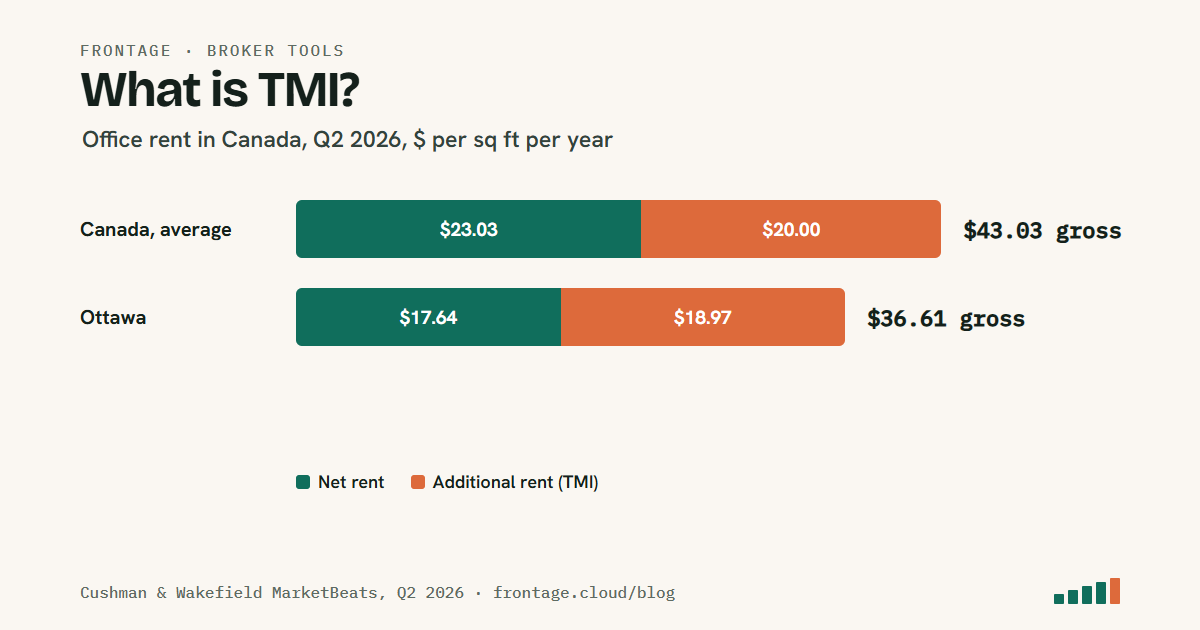
On a Canadian commercial lease, the rent on the offer is rarely the rent you pay. TMI, the taxes, maintenance and insurance passed through as additional rent, sat at $20.00 a square foot on the average Canadian office in mid-2026, almost as much as the net rent itself [16]. Here is what TMI covers, what it costs by market, how it is billed, and what to negotiate.
Key takeaways
- TMI is additional rent: the taxes, maintenance and insurance the landlord passes through to tenants on top of base rent, under the net leases common across Canada [1, 2].
- It is a big number. Canadian office additional rent averaged $20.00 per square foot in Q2 2026, against $23.03 net rent [16]; industrial runs about $3 to $9 [20, 21, 24].
- It is estimated monthly and trued up once a year, and the tenant can ask for the documents behind the year-end statement [13].
- HST applies to it. The Canada Revenue Agency treats a tenant's payment toward property taxes as part of the rent [27].
- It is negotiable: a precise list of what is included, a cap on increases, capital costs excluded, and audit rights [1, 25, 30].
What TMI means, and how it differs by lease type
Additional rent is “everything the tenant owes the landlord beyond the base (or ‘minimum’) rent”, and TMI names its three main buckets: “Taxes, Maintenance, and Insurance” [1]. It is also called operating costs or common area maintenance (CAM) [5]. Baker McKenzie describes the net lease, in which the tenant pays basic rent plus a proportionate share of realty taxes, insurance, utilities and common area maintenance, as “the most typical form of a commercial lease” in Canada [2].
The labels are used loosely, so read the clause, not the name. BDC calls a lease “net” when the tenant pays just one extra item, most often property taxes [4], while many Ontario lawyers use “net” for the full TMI pass-through [1, 5]. Quebec practice names four levels [28]:
| Lease | What the tenant pays | Source |
|---|---|---|
| Gross | One amount covering base rent and all incidental expenses | [3] |
| Semi-gross | Base rent, plus increases in operating costs over a base year | [6] |
| Net (single net) | Base rent plus one category, usually property taxes | [4, 28] |
| Double net | Base rent plus two categories | [28] |
| Triple net | Base rent plus taxes, insurance and the other operating and maintenance costs | [3, 28] |
What is in each bucket
| Bucket | Usually includes | Watch for | Source |
|---|---|---|---|
| Taxes | Realty taxes, shared by area | Often the biggest single item | [1, 29] |
| Maintenance (CAM) | Snow removal, landscaping, janitorial, parking lot repair and lighting, minor roof repairs, property management | Capital work billed as maintenance | [1, 3] |
| Insurance | The landlord's insurance on the building | Premium spikes passed straight through | [1, 25] |
| Administration fee | A percentage on top of costs, often 15% of operating costs | Charged on taxes and insurance too, or twice with a separate management fee | [8, 9, 10] |
Capital costs are the usual fight. Tenants commonly try to exclude structural repairs, capital costs, depreciation and financing costs [10]. Ontario courts have refused to let landlords recover capital work the lease excluded, including a parking-lot resurfacing, and a tenant's lump-sum share of a repaving [11]. Where replacement is recoverable, it is often amortized: an HVAC unit with a 20-year life replaced in year 5 of a 10-year lease costs the tenant 5/20ths [12]. And an administration or management fee has to be written into the lease; calling a lease “net” is not enough to charge one [8].
What TMI costs in 2026
Few reports publish additional rent separately, so the figures below come from the ones that do, all for Q2 2026 unless marked.
| Market | Net rent | Additional rent (TMI) | Gross rent | Source |
|---|---|---|---|---|
| Canada, average | $23.03 | $20.00 | $43.03 | [16] |
| Ottawa | $17.64 | $18.97 | about $36.61, derived | [17] |
| Calgary | $16.13 | about $18.86, derived | $34.99 | [18] |
| Downtown Toronto core | not given | typically $20–$35 | not given | [19] |
The Ottawa gross is our addition of the two published figures [17], and the Calgary additional rent our subtraction of the published net from the published gross [18]; neither report states them. The Toronto range is Newmark's, from its 1Q26 report [19].
| Market | Net rent | Additional rent | Source |
|---|---|---|---|
| Greater Toronto Area | $16.03 | $4.28 | [20] |
| Greater Vancouver | $18.87 | $6.16 | [21] |
| Calgary | $10.68 | $4.92 | [22] |
| Ottawa | $16.75 | $6.19 | [23] |
| Montreal | $14.06 | $4.68 | [24] |
How TMI is billed and reconciled
At the start of each year the landlord estimates operating costs, the tenant pays monthly instalments on that estimate, and a year-end statement adjusts the difference between estimated and actual costs [13]. In Quebec the annual regularization is a credit or a supplement to the actual figure [15]. One Ontario court held it commercially reasonable to imply a term requiring the landlord to deliver, with the annual adjustment, the tax bills, insurance premiums and management invoices behind it [13]. Treadstone suggests asking for the statement within 120 days of year-end and a right to inspect the records within 12 to 18 months [1]; tenants who cannot get audit rights can instead negotiate a cap on how much additional rent can grow [14].
TMI, free rent and net effective rent
Statistics Canada's net effective rent includes inducements and excludes “all operating costs, taxes and additional rents” [26], so two offers compared on net effective rent can still cost very differently once TMI is added. Compare gross effective rent too: the same calculation with additional rent included. Check the free-rent clause as well: free rent usually waives base rent only, so the tenant keeps paying TMI unless the lease says the free period is gross. That is general practice, not a statistic; the clause decides.
HST applies to TMI
Some broker sites say HST applies to rent but not to TMI. The Canada Revenue Agency says otherwise: where a tenant pays a separate amount on account of property taxes, “this amount is part of the consideration for the rental of the property”, so it is taxed like the rent, unless the tenant is directly liable to the municipality [27].
What to negotiate
- A precise, exhaustive list of what TMI includes [30].
- A cap on increases. “In most leases, there is no cap on operating costs” [25]; caps on controllable costs are often 3–5% [1], measured against a base year or year over year, cumulative or compounding [25]. Insurance can jump: BC premiums rose 50–700% during its insurance crisis [25].
- Capital costs excluded, with any recoverable replacement amortized over its useful life [1, 10, 12].
- A sensible gross-up: if variable costs are grossed up as though the building were full, ask for 95% occupancy rather than 100% [6].
- The administration fee kept off taxes and insurance [10].
- Audit rights and a deadline for the year-end statement [1, 14].
Questions
What does TMI stand for in a commercial lease?
Taxes, maintenance and insurance: the three main operating costs a Canadian landlord passes through to tenants as additional rent under a net lease, on top of base rent. It is also called operating costs or common area maintenance (CAM).
How much is TMI on an office lease in Canada?
Cushman & Wakefield put Canadian office additional rent at $20.00 per square foot on average in Q2 2026, against $23.03 net rent. Ottawa averaged $18.97, and Newmark gives $20 to $35 for downtown Toronto core buildings. Industrial TMI runs about $3 to $9.
Is TMI the same as CAM?
Mostly. CAM (common area maintenance) is the maintenance part; TMI adds taxes and insurance. Leases use additional rent, operating costs, CAM and TMI loosely, so the lease's own definition is what counts.
Do I pay TMI during free rent?
Usually yes. Free rent in Canadian leases commonly waives base rent only, so the tenant keeps paying TMI unless the lease makes the free period gross. Check the clause.
Is HST charged on TMI?
Yes, generally. The Canada Revenue Agency treats a tenant's separate payment toward property taxes as part of the consideration for the rental, so it is taxed like the rent, unless the tenant is directly liable to the municipality.
Can a landlord charge a management fee on top of TMI?
Only if the lease says so. An Ontario decision held a management charge cannot be passed on simply because a lease is described as net. Where it is allowed, 15% of operating costs is common; tenants try to keep it off taxes and insurance.
The free net effective rent calculator reports additional rent beside net rent and never nets it in, so two offers with different TMI are compared honestly.
Sources
Law firms, government sources and market reports, current to September 2026. Where a figure is derived rather than published, the text says so.
- Treadstone Law, TMI in an Ontario commercial lease: what you actually pay, Aug 20, 2026.
- Baker McKenzie, Global Corporate Real Estate Guide: Canada, leases, undated.
- BDC, 13 commercial leasing terms you need to know, undated.
- BDC, 12 tips for negotiating a commercial lease, undated.
- Carrel+Partners LLP, Commercial leasing basics, Jun 13, 2025.
- Blake, Cassels & Graydon, Commercial lease gross-ups (via Mondaq), Feb 2009.
- Law Society of Alberta, 5.4 Commercial lease considerations, Feb 9, 2026.
- McMillan LLP, Charging management fees or administration fees to tenants under a net lease (via Mondaq), Nov 20, 2012.
- Gestion MJS, Administration fees in commercial leases, Sep 8, 2020.
- McKenzie Lake Lawyers, Do you know what's hiding in your operating costs?, updated Jun 3, 2020.
- Robins Appleby LLP, Capital repairs: an update, Jun 2013.
- Grigoras Law, Who pays for the broken HVAC? Commercial lease repair obligations in Ontario, undated.
- McCarthy Tétrault, Operating cost statements: how much information is enough? (via Mondaq), Aug 19, 2016.
- Houser Henry & Syron LLP, Top 5 tenant issues in a commercial lease (via Mondaq), Mar 20, 2019.
- ZS Avocats, Loyer additionnel dans un bail commercial au Québec, Mar 22, 2025.
- Cushman & Wakefield, Canada Office MarketBeat Q2 2026, Q2 2026.
- Cushman & Wakefield, Ottawa Office MarketBeat Q2 2026, Q2 2026.
- Cushman & Wakefield, Calgary Office MarketBeat Q2 2026, Q2 2026.
- Newmark, Downtown Toronto Office Market Overview 1Q26, 1Q 2026.
- Cushman & Wakefield, Toronto Industrial MarketBeat Q2 2026, Q2 2026.
- Cushman & Wakefield, Vancouver Industrial MarketBeat Q2 2026, Q2 2026.
- Cushman & Wakefield, Calgary Industrial MarketBeat Q2 2026, Q2 2026.
- Cushman & Wakefield, Ottawa Industrial MarketBeat Q2 2026, Q2 2026.
- Cushman & Wakefield, Montreal Industrial MarketBeat Q2 2026, Q2 2026.
- Lawson Lundell LLP, Negotiating caps for operating costs in commercial leases (via Mondaq), Aug 27, 2020.
- Statistics Canada, The Daily: Commercial rents in key Canadian economic markets, Q4 2025, Mar 5, 2026.
- Canada Revenue Agency, GST/HST Memorandum 19.4.1, Commercial real property: sales and rentals, Aug 1999, current.
- Stein Monast, Les baux commerciaux : brut, net, double net ou triple net?, Oct 13, 2020.
- Éducaloi, 5 choses à savoir sur le bail commercial, undated.
- UL Lawyers, Commercial lease agreements in Ontario: your 2026 guide, undated.
General information for real estate professionals and tenants, not legal, tax, accounting or commercial real estate advice. Figures are as published by each source at the dates shown and have not been independently verified. Lease terms and laws differ by province and by lease: read the lease itself and consult a qualified adviser before acting or advising a client.