Broker tools
How to compare commercial lease offers, step by step
Two landlords can quote rents two dollars apart and still be offering the same deal, or the reverse. The number that settles it is net effective rent: the rent actually paid once free rent and allowances are netted out. Here is how to get there, step by step, with a worked example in which the “cheaper” offer costs about $113,500 more.
Key takeaways
- Compare net effective rent, not face rent. Net effective rent is the price to occupy the space including inducements and excluding operating costs, taxes and additional rent [1].
- Two methods are accepted: a simple straight-line average, or a discounted present value spread back over the term [3]. Show both.
- Then add TMI. Net effective rent leaves additional rent out, so compare gross effective rent too.
- Landlords are holding face rents and paying through concessions [18, 21], which is exactly when face rent misleads.
Why face rent misleads
“Landlords aren't cutting face rents in most markets. They're extending concessions to close deals, which compresses effective rent without moving the headline asking number,” CompStak wrote in August 2026 [18]. In Metro Vancouver industrial, Avison Young saw the same: “rising availability is prompting landlords to secure tenants through inducements rather than by reducing rents” [21]. In US office, Newmark put improvement allowances 61.1% above pre-pandemic levels in early 2025 [19] and roughly 75% above by early 2026 [20]. When the headline rate stands still and the concessions move, only a comparison that nets them out shows the real price.
What is on an offer
| Term | What it is | Source |
|---|---|---|
| Basic (net) rent | The minimum rent per square foot, often fixed at the start and increasing each year | [8, 11] |
| Term | Most Canadian commercial leases run 5 or 10 years | [8] |
| Free rent | A period without basic rent; additional rent and utilities may still be payable | [10] |
| Fixturing period | Time before the term starts to fit out the premises, often without basic or additional rent; in Vancouver office, typically 3–6 months outside the term | [9, 10, 14] |
| Improvement allowance | Dollars per square foot from the landlord toward build-out, engineering, space planning and permits | [4, 10] |
| Landlord's work | Work the landlord does before the tenant takes the space | [9] |
| Additional rent (TMI) | Taxes, maintenance and insurance passed through on top of basic rent | [8, 12] |
| Renewal option | Not a right by default; must be in the lease, and a missed deadline is fatal | [8, 16] |
Net effective rent: the one number
Statistics Canada defines net effective rent as “the price charged to all tenants to physically occupy space in the building each month, including any inducements and excluding all operating costs, taxes and additional rents” [1]. The straight-line version is simple: take the rent over the whole term, subtract the free rent and the allowances, and divide by the term [5]. The federal government's valuation guidelines accept it “on a discounted basis, reflecting the time value of money, or on a simple, straight-line basis” [3]; the REALpac/AIC definition used in appraisal is the discounted one, and also deducts commissions because it takes the landlord's view [2].
Worked example: two offers, step by step
Our own example, on stated assumptions: two five-year offers on the same 5,000 square feet.
| Term | Offer A | Offer B |
|---|---|---|
| Net rent | $22.00 years 1–2, $23.00 years 3–5 | $20.00 flat |
| Free rent | 4 months (net) | 1 month (net) |
| Improvement allowance | $30.00/sf | $15.00/sf |
| Additional rent (TMI) | $16.00/sf | $19.00/sf (older building) |
- Rent over the term. A: 5,000 sf × ($22 × 2 years + $23 × 3 years) = $565,000. B: 5,000 × $20 × 5 = $500,000.
- Less free rent, at the rate in force when it falls: A, 4 months × $22 ÷ 12 × 5,000 = $36,667. B, 1 month × $20 ÷ 12 × 5,000 = $8,333.
- Less the allowance: A, $30 × 5,000 = $150,000. B, $15 × 5,000 = $75,000.
- Divide by the term and the area: A, $378,333 ÷ 5 ÷ 5,000 = $15.13. B, $416,667 ÷ 5 ÷ 5,000 = $16.67.
- Add TMI for gross effective rent: A, $15.13 + $16.00 = $31.13. B, $16.67 + $19.00 = $35.67.
| Measure | Offer A | Offer B |
|---|---|---|
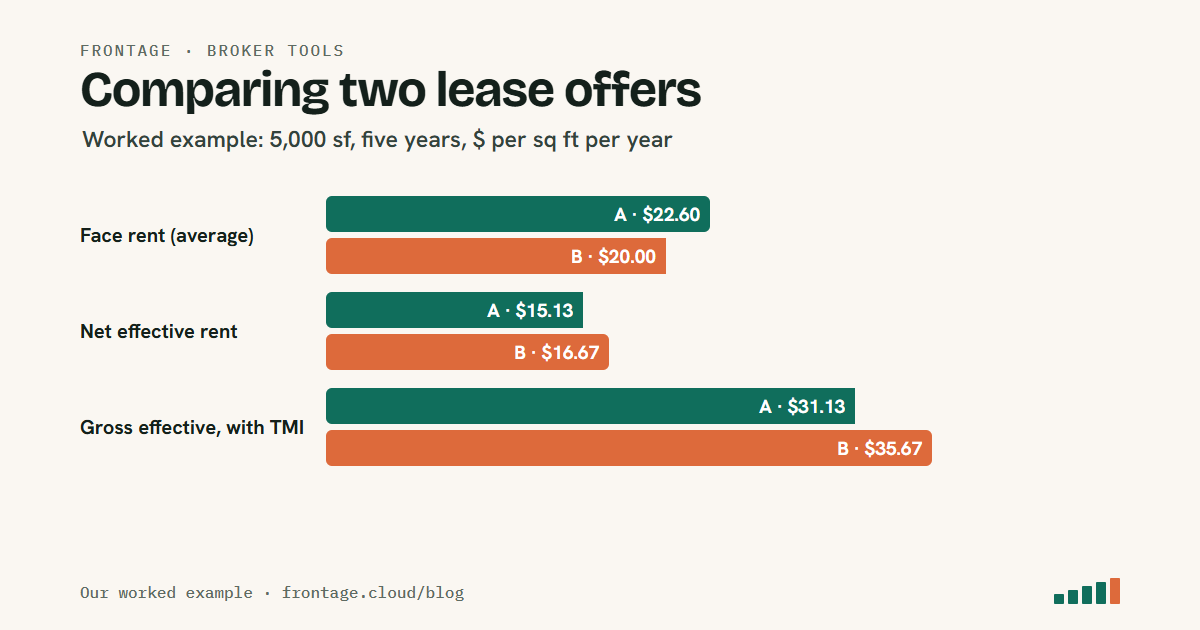
| Face rent (average) | $22.60 | $20.00 |
| Net effective rent, straight-line | $15.13 | $16.67 |
| Net effective rent, discounted at 8% | $13.60 | $16.00 |
| Gross effective rent (with TMI) | $31.13 | $35.67 |
Offer B looks $2.60 cheaper and is $4.54 dearer on gross effective rent: over five years on 5,000 square feet, about $113,500. The allowance only counts in full if the tenant will spend it on improvements it needs; any fit-out cost above it is the tenant's.
Straight-line or discounted?
Brokers usually quote the straight-line figure because it is simple to check. The discounted figure credits money received sooner, such as an allowance paid at the start, and PropertyMetrics' worked comparison uses 8% as “your opportunity cost or cost of capital” [7]; UBC's appraisal course works leasehold examples at 8% to 12% [2]. Corporate tenants typically discount at their weighted average cost of capital [17]. Here the discounted figure widens A's lead from $1.54 to $2.40.
Check the method against published examples. The straight-line method above reproduces UBC's worked example ($12.65) [2] and CompStak's ($53.08) [5] to the cent, which is also how the free net effective rent calculator works.
What the number leaves out
- Measurement. BOMA's office standard was revised in 1996, 2010 and 2017, and the version used changes the rentable area, so two buildings' per-square-foot figures may not be on the same basis [25]. In Toronto, existing offices typically use BOMA 1996 and new developments BOMA 2017 [13].
- Flexibility: renewal and termination rights, assignment and subletting, guarantees and letters of credit, where “seemingly minor lease provisions can have multi-million dollar implications” [24].
- The allowance in context: never judge it alone; weigh it with starting rent and free rent [26].
Concessions in Canada today
Reliable, dated Canadian figures for free rent and allowances are scarce. Colliers' occupier guides give ranges for office: Toronto, 2 to 12 months free and $20 to $80 per square foot of improvements; Vancouver, 0 to 3 months free and $70 to $150; Montreal, 2 to 24 months free and $10 to $50 [13, 14, 15]. The guides are undated, so treat them as orders of magnitude. The direction is clearer: net effective rent for downtown Toronto's top office towers rose 20% in a year to $30.50 in Q2 2025, per Altus, as landlords cut back on free rent and build-out cash [22], while suburban landlords still offered early fixturing in 2026 [23].
Questions
How do you compare two commercial lease offers?
Reduce each to net effective rent: the rent over the term, less free rent and the landlord's allowances, divided by the term and the area. Then add each building's additional rent (TMI) for gross effective rent, and weigh what the number leaves out, such as measurement, renewal and termination rights.
What is the formula for net effective rent?
Straight-line: (total rent over the term − free rent − improvement allowance and other inducements) ÷ term in years ÷ rentable area. The discounted version takes the present value of the same cash flows and spreads it back over the term as a level payment.
Should I use straight-line or discounted net effective rent?
Both are accepted. Straight-line is simpler and is what brokers usually quote; discounted credits money received sooner. Showing both is the honest answer, and the ranking of two offers rarely changes between them.
What discount rate should I use?
The tenant's cost of capital; corporate tenants typically use their weighted average cost of capital. Published worked examples use 7% to 12%.
Is TMI included in net effective rent?
No. Net effective rent excludes operating costs, taxes and additional rent by definition, so compare gross effective rent (net effective rent plus TMI) as well, especially between an older and a newer building.
How much free rent and allowance do Canadian landlords offer?
It varies widely by market and building. Colliers' undated occupier guides give 2 to 12 months free and $20 to $80 per square foot of improvements for Toronto office; in the best downtown towers, landlords have been cutting back.
The free net effective rent calculator does all of this for any two offers, straight-line and discounted, with every step shown and TMI kept beside it.
Sources
Government sources, appraisal texts, law firms and market research, current to September 2026. The worked example is our own, on the assumptions stated.
- Statistics Canada, The Daily: Commercial rents in key Canadian economic markets, Q4 2025, Mar 5, 2026.
- UBC Sauder School of Business, Real Estate Division, Chapter 6: Valuation of leasehold interests (quoting the REALpac/AIC definition), undated; definition from 2001.
- Public Services and Procurement Canada, Valuation guidelines: valuation program products in support of leasing, modified Apr 9, 2025.
- Avison Young, Calgary office market report Q4 2025 (glossary), Q4 2025.
- CompStak, Asking rents won't tell you the full story, Feb 19, 2021.
- CompStak, Net effective rent vs asking rent: why the gap matters for CRE underwriting, Aug 9, 2026.
- PropertyMetrics, Introduction to comparative lease analysis, Nov 26, 2024.
- Baker McKenzie, Global Corporate Real Estate Guide: Canada, leases, undated.
- TDS Law, Offers to lease, May 23, 2019.
- Lime Law, Commercial leases: what every business needs to know, Jun 27, 2025.
- Lawrence, Lawrence, Stevenson LLP, Basic rent and additional rent in a commercial lease, undated.
- Treadstone Law, TMI in an Ontario commercial lease: what you actually pay, Aug 20, 2026.
- Colliers, Global Occupier Guide: Toronto, undated.
- Colliers, Global Occupier Guide: Vancouver, undated.
- Colliers, Global Occupier Guide: Montreal, undated.
- Parlee McLaws, Deconstructing the option to renew/extend clause in commercial leases, May 2018.
- Connect CRE, Consider discount rate when weighing lease versus own, Jan 5, 2023.
- CompStak, 2026 industrial gateway market overview, Aug 7, 2026.
- Newmark, 1Q25 U.S. Office Leasing House View, May 13, 2025.
- CRE Daily, Office construction hits 14-year low as concessions rise (Newmark 1Q26), May 19, 2026.
- Avison Young, Metro Vancouver industrial market report Q3 2025, Q3 2025.
- The Globe and Mail, Toronto office landlords see tenant demand return (Altus data), Sep 8, 2025.
- Daily Commercial News, JLL: downtown Toronto office leasing surges as high rents push tenants to suburbs, Aug 19, 2026.
- Vestian, Understanding office lease negotiation: a tenant's perspective, Aug 1, 2024.
- Building.ca, Measure twice, cut once (BOMA measurement standards), Jan 15, 2019.
- CompStak, Tenant improvement allowance guide, Aug 25, 2026.
General information for real estate professionals and tenants, not legal, tax, accounting or commercial real estate advice. Figures are as published by each source at the dates shown and have not been independently verified. Lease terms and laws differ by province and by lease: read the lease itself and consult a qualified adviser before acting or advising a client.