Lease expiries
Office lease renewal timeline: The Expiry Clock
Every office lease is a dated opportunity, and lease expiration is only the last date on it. The broker who reads the lease three years out, puts the landlord’s renewal offer beside real alternatives, and knows whether the client’s decision creates one deal or two, wins the mandate before anyone else calls. This is the month-by-month timeline, the deal map and the math, with every figure traced to a North American source.
Key takeaways
- Start early, by size. Sources range from 6–12 months for small tenants to 18–36 months for large or complex ones [18, 15]. This playbook recommends 18 months under 10,000 sf, 24 months for 10,000–50,000 sf and 36 months over 50,000 sf or for new construction.
- The renewal notice period usually ends 6 to 12 months before expiry [25], sometimes 18 to 24 in Ontario [28]. Late or misdelivered notice normally loses the option [25, 29].
- One deal or two depends on leftover term, not on staying or leaving. A renewal is one transaction. Staying and subletting part of the space is two. Moving at natural expiry is one; moving while term remains on the old lease is two, because the old space has to be sublet, assigned or bought out.
- Waiting is getting more expensive for tenants in good space. New office construction is at a 14-year low in both the US and Canada, and US vacant sublease space fell 15.4% in a year [1, 2].
- A sublease leaves the tenant liable, and in Canada the original tenant stays liable even after an assignment unless the landlord releases it [38, 41].
Why now: the office market in 2026
The market has turned from “tenants hold all the cards” to “tenants in good space are running out of time”. About 1.4 billion square feet of pre-pandemic US office leases expire between 2025 and 2027 [5]. US office under construction is 19.7 million square feet, under 30% of the long-term norm [1]; Canada has 1.9 million square feet under construction, a 14-year low [2].
Research firms measure vacancy differently, so headline rates disagree: US vacancy runs from just under 14% to about 21% depending on the source [62, 12], Canada’s from under 10% to 17.7% [63, 10, 11]. The table uses one series, Cushman & Wakefield’s Q2 2026 MarketBeats, so markets compare fairly. Quote one series to a client, and name it.
| Market | Vacancy, Q2 2026 | Direction | What it means for timing |
|---|---|---|---|
| United States | 20.1% | Flat for eight quarters; Class A down 50 bps a year [1] | Top-tier space tightening, commodity space still loose |
| Canada | 16.1% | Down 80 bps a year; central B/C stuck at 21.0% [2] | Flight to quality: start early for A space |
| Vancouver | 11.6% | Up 40 bps on the quarter [3] | Tightest major Canadian market on this series |
| Toronto | 13.6% | Down 60 bps on the quarter, lowest since Q4 2022 [3] | Downtown Class A options disappear first |
| Ottawa | 13.7% | Still rising [3] | Tenant leverage holding |
| Edmonton | 17.5% | Down 120 bps a year [3] | Improving fastest; leverage narrowing |
| Montréal | 17.9% | Rising; AAA only 9.2% [3] | Tight at the top, loose below |
| Calgary | 21.3% | Down 130 bps a year [3] | Most tenant-favourable; highest availability in Canada [9] |
Tenants are holding space, not cutting it. 78% of companies plan to keep or grow their footprint at renewal, though average lease size is still 13.4% below pre-pandemic [4]; only 32% of occupiers planned further cuts [13]. They are buying quality: four- and five-star buildings took 49% of new US leasing in Q2 2026 while making up 34% of inventory [4], and JLL expects “relocation options, particularly upgrade options for Class A tenants” to become more limited [59]. Leasing is back: US leasing hit a post-pandemic high in Q2 2026, up 27% over the trailing 12 months against the previous five-year average [8]. Office occupancy reached 56.3% in Kastle’s 10-city index in the week to 16 September 2026 [6]. Placer.ai counted August 2026 office visits 32.5% below August 2019, the smallest August gap since the pandemic [7].
Concessions are still generous, for now. US improvement allowances are about 73% above pre-pandemic levels [4]. In the tightest markets that is turning: the weighted average rent abatement on new Manhattan deals was 12.4 months in H1 2026, the lowest since 2019 [14], and the sublease tier that “functioned as the discount tier” is shrinking [50].
The office lease renewal timeline, month by month
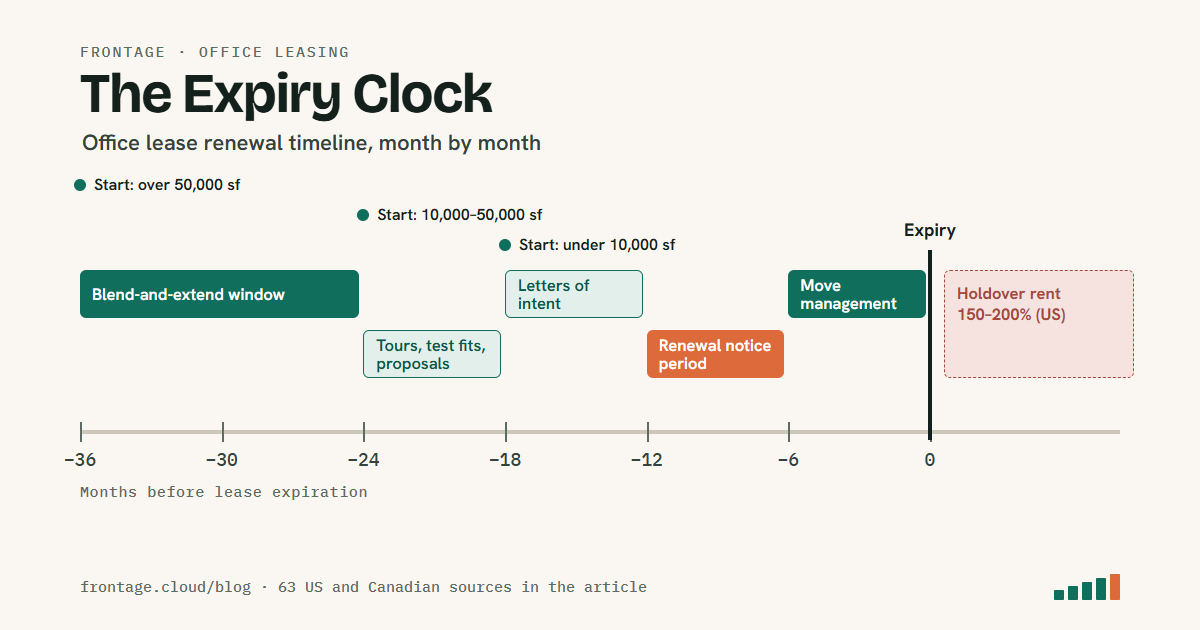
Colliers says to “begin no later than 12 months before the end of the lease”, with 18 to 36 months for larger or complex requirements [15]. JLL says to be ready to begin discussions 18 to 24 months ahead, and calls underestimating lead time “a common mistake” [16]. The US federal government starts planning 36 to 42 months out, and 60 months for its largest leases [19, 20]. Even so, 54% of its long-term leases that expired in 2012–2014 ended in holdover or extension [21]. Starting late is the norm.
| Tenant size | What sources say | This playbook’s start |
|---|---|---|
| Under 10,000 sf | 6–12 months [18]; renewals 12–18 months [17] | 18 months |
| 10,000–50,000 sf | 12 months [18]; 18–24 months [16]; relocations 18–24 months [17] | 24 months |
| Over 50,000 sf, or new build | 18–24 months [18]; 18–36 months [15]; US federal 36–60 months [19] | 36 months |
The right-hand column is this playbook’s recommendation, not a published standard. It sits at the early end because option notice windows commonly close 6 to 12 months before expiry [25], and a landlord only negotiates hard against alternatives the tenant could still take.
| Months before expiry | The broker’s move | The opportunity or the risk |
|---|---|---|
| 36 and earlier | First contact. Abstract every date in the lease: expiry, option notice, termination, rights of first offer. Learn the business plan. | Blend-and-extend: renewing early, adding term for today’s rate and concessions, “anywhere from 12 months to several years” before expiry [34], typically once half the term or less remains (a 2011 rule of thumb [57]). |
| 36 to 24 | Large and complex requirements start [15]. Run the utilization study and the stay-or-go model. | Pre-leasing the little new space there is, which is committed early or not at all [1, 2]. |
| 24 to 18 | Tour, test-fit and request proposals from the current landlord and two or three alternatives at the same time [16, 17]. | Leverage: “Utilizing lead time in negotiating a lease renewal gives the tenant leverage, which creates savings” [61]. Decide now whether surplus space should be sublet, while the term still has value. |
| 18 to 12 | Negotiate letters of intent in parallel. Some Ontario leases need option notice as early as 18 to 24 months out [28]. | A move that needs fit-out is decided about now: meaningful improvements take 9 to 18 months to deliver [15]. |
| 12 to 6 | Renewal notice usually falls here: 6 to 12 months in the US [25], often 6 to 9 in BC [26, 27]. Termination options typically need 9 to 12 months’ notice [36]. A 20,000 sf fit-out takes about 20 weeks in second-generation space and 32 from shell, by 2018 estimates [22]; Toronto reviews a complete permit application in 20 to 30 business days [23]. | Risk: an option is lost by late notice, by email when the lease requires certified mail, or by sending it to the property manager instead of the notice address [25]. Ontario gave relief once, in 2025, for notice five weeks late; it is discretionary [29]. |
| 6 to 0 | Move management starts 4 to 6 months out for moves up to 50,000 sf [24]. | A short extension, or a permitted holdover clause: one 2026 lease allows up to four months at 100% of the last rent if elected eight months ahead [32]. |
| After expiry | Holdover, and holdover rent. | US landlords commonly charge 150% to 200% of base rent [30]; 115% to 150% is commonly negotiated in Ontario [31]. Holdovers “limit the negotiating power … due to a lack of competition” [20]. |
To turn one lease’s expiry date into these milestones, or a whole list of them into a call calendar, use the free lease expiry check. To find these tenants in your own book every week, read the Monday lease expiry sweep.
One deal or two: renewal, sublease and relocation
At expiry the client makes one decision, but it can create one transaction or two. What decides it is not “stay or go”; it is whether any term is left on space the client no longer wants. That leftover term is the second deal: a sublease, an assignment or a buyout.
| The client’s decision | Deals | What they are | What to watch |
|---|---|---|---|
| Renew as is | Single | Renewal or extension | Renewal terms average 94.1 months in gateway markets, about 27 months shorter than new leases [58]. A renewal at market often carries no allowance or free rent unless negotiated [27]. |
| Renew early (blend-and-extend) | Single, sooner | Extension signed years before expiry | Immediate rent relief, early improvement money, a chance to shed surplus space [57]. |
| Stay and grow | Single | Renewal plus expansion space | Rights of first offer or refusal decide whether the space is there; response windows are often 5 to 10 business days [37]. |
| Stay and give space back | Single | Renewal with contraction, or a negotiated surrender | A contraction option has a notice period and usually a fee [36]. |
| Stay and sublet part | Double | Renewal plus a sublease listing | The client stays liable for the sublet space [38]; the landlord’s consent, recapture right and profit share apply. |
| Move at expiry (same, smaller or bigger) | Single | New lease; the old space returns to the landlord | No leftover term, so no second tenant-side deal. Listing the vacated space would be a landlord mandate: a different client, and a conflict to disclose. |
| Move before expiry | Double | New lease plus disposing of the old: sublease, assignment or buyout | In Canada the original tenant stays liable even after an assignment unless released [41]. |
| Move but keep the old space and sublet it | Double | New lease plus a sublease listing | Only if the arithmetic works: sublease rent, downtime and costs against a buyout (below). |
| Do nothing | None | Holdover | 150–200% of rent in the US [30], and no leverage. |
Sublease, assignment or surrender: the rules behind the second deal
Liability. In a sublease the original tenant remains liable under its lease, including for rent; an assignee takes over the obligations, but the assignor usually stays liable unless the landlord releases it [38]. The Supreme Court of Canada held the original tenant liable even after the assignee went bankrupt [41]. Ask for the release in writing, as part of the deal.
Consent. In Ontario, unless the lease says otherwise, the landlord’s consent to an assignment or sublet will not be unreasonably withheld, by statute; a late answer counts as unreasonable, and “a conditional consent is not a consent” [39]. British Columbia has no such statute, and courts generally enforce “sole” or “absolute” discretion where the lease says so [40]. In the US the standard varies by state [38].
Recapture and profit. Many leases let the landlord take the space back when the tenant asks to sublet, which ends the second deal. The most common compromise on sublease profit is a 50/50 split of net profit, after commissions, allowances and rent paid while the space sat empty [42].
Stay or go: the math
Compare options on net effective rent and total occupancy cost over the same period, never on face rent. The free net effective rent calculator puts any two offers on one basis. The cost lines that decide a move:
| Cost line | Published figure | Caveat | Source |
|---|---|---|---|
| Fit-out, US and Canada, all-in | US$295/sf average, range $230–375 | Includes furniture, IT and fees | [48] |
| Fit-out, Toronto | CA$204/sf; about CA$307/sf all-in | Vancouver $199, Montréal $190, Calgary $181 (base) | [49] |
| Sublease rent against direct | About 25–27% below | 2021–2022 data; narrowing where sublease supply is shrinking | [43, 44, 50] |
| Time to sublet a large block | About 18 months on market | Houston, 2023: one market | [45] |
| Sublease commission | 6% of gross sublease rent | Austin example; consent fees $500–5,000 | [47] |
| Early termination fee | Unamortized improvements and commissions plus 2 to 9 months’ rent | The rent part varies by lease | [33, 36] |
Time erodes a sublease. Remaining term is “a key determining factor” in what a subtenant will pay. In one published example, subletting 5,000 sf with 36 months left at $42 against a $50 lease recovers 85% of the obligation by the source’s count ($42 is 84% of $50); waiting six months to get $50 recovers only 83% [46]. A lower rent now can beat a better rent later.
Worked example: sublet or buy out?
Our own illustration, on assumptions stated in full, before tax and without discounting: 5,000 sf with 36 months left at $50/sf/yr, so $750,000 still owed.
| Line | Sublet | Buy out |
|---|---|---|
| Assumptions | Subtenant found in 6 months at $40/sf/yr; 6% commission; $5/sf allowance to the subtenant; $5,000 consent and legal fees | Fee of 6 months’ rent plus $40,000 of the landlord’s unamortized costs |
| Money in | $500,000 of sublease rent over 30 months | None |
| Costs | $30,000 commission, $25,000 allowance, $5,000 fees | $125,000 fee plus $40,000 |
| Net cost to the client | $310,000, and still liable if the subtenant defaults | $165,000, and the lease is over |
On these inputs the buyout wins by $145,000, and it also ends the client’s liability, which a sublease never does [38]. Change the sublease rent, the downtime or the fee and the answer can flip, which is why the math comes before the recommendation. For a real decision, discount the cash flows and take the termination figure from the lease.
The accounting angle
Since IFRS 16 and ASC 842, most leases sit on the tenant’s balance sheet; before them, over 85% of listed companies’ US$3.3 trillion of lease commitments were off it [56]. The lease term includes renewal options the tenant is “reasonably certain” to exercise, and high relocation costs can make an option reasonably certain [54], so term length and renewal timing are questions for the client’s CFO too. Canadian private companies reporting under ASPE still keep operating leases off the balance sheet [55].
Six early plays
- Blend and extend (36 months or earlier): trade added term for today’s rate, fresh improvement money and a chance to shed space [57, 35]. In a sponsored case study published with JLL, one tenant that started two years early cut base rent by 20% [60].
- Upgrade before the supply goes (36 to 24 months): Class A options are narrowing and new construction is at a 14-year low [1, 2].
- Right-size at renewal (24 to 18 months): lease sizes are still 13.4% below pre-pandemic [4]. Give space back to the landlord, or keep it and sublet it: the second is a double deal.
- Sublet while the term has value (as soon as space is surplus): every month of term lost lowers what a subtenant pays [46].
- Calendar every option window (any time): a missed or misdelivered notice loses the option [25, 26], and the reminder is a reason to call.
- Negotiate the exits in (at signing): a permitted holdover at 100% rent [32], a termination option with a formula fee [33], a release on assignment [41] and a 50/50 net profit share [42].
Read the lease first: six clauses to abstract
- Expiry, and any early termination date.
- Renewal option: the notice window, the delivery method and address, how market rent is set (an average of three brokers’ opinions, or baseball arbitration [33]), and whether allowances apply on renewal.
- Holdover: the holdover rent, and any permitted holdover period [30, 32].
- Termination or contraction: the notice period and the fee formula [36].
- Expansion: right of first offer or refusal, the space covered, the response time [37].
- Assignment and subletting: the consent standard, recapture, profit sharing, and whether the original tenant is released [38, 39, 42].
Getting paid on renewals and subleases
In most commercial leases the landlord pays the commission, calculated on the rent over the term and split between the listing and tenant brokers [51]. In Canada it is often quoted per square foot per year; one Ontario brokerage cites 3–6% of base rent or $1–3/sf/yr [53]. Renewals are the trap: “most landlords will refuse the tenant representative any compensation beyond commission based on the initial lease term” [52], and the same Ontario source puts a renewal at half the initial commission [53]. On a sublease your client, the sublandlord, usually pays [47]. Put the renewal, any expansion, and the sublease or assignment into the representation agreement before the first proposal.
What the data can’t tell you
Several numbers brokers quote most have no current national source. Get them from your own market:
- Today’s sublease discount. The last well-sourced figures, about 25–27% below direct, are from 2021–2022 [43, 44]; in tight markets it has narrowed [50].
- Improvement allowances and free rent by class. Only trends and single-market figures are published [4, 14]; the often-quoted “$70–90/sf” has no research source.
- Moving and IT costs, and buyouts as a share of remaining rent. Only vendor estimates and deal-specific formulas exist.
- How many private tenants start late. The only hard data is US federal [21, 20].
- Canadian lease-expiry volumes for 2025–2028. No public figure was found.
Questions
How early should an office tenant start a lease renewal?
Published guidance ranges from 6–12 months for tenants under 10,000 square feet to 18–36 months for large or complex requirements. Starting 18 months ahead under 10,000 sf, 24 months for 10,000–50,000 sf and 36 months above that leaves time to build real alternatives before the renewal option notice window, which commonly closes 6 to 12 months before expiry.
What is the renewal notice period for an office lease?
Most office leases require written notice 6 to 12 months before expiry, often 6 to 9 months in British Columbia, and some Ontario leases require 18 to 24 months. The lease sets the exact window, the delivery method and the notice address; missing any of them usually loses the option.
What is a blend-and-extend?
A blend-and-extend is an early lease renewal: the tenant adds term, often years before expiry, in exchange for a blended rent closer to today’s market and fresh concessions such as improvement money or the chance to give back space. It works best once half the term or less remains.
Is a lease renewal one transaction or two?
A straight renewal is one transaction. It becomes two when the tenant renews and sublets part of its space, or moves while term remains on the old lease, because the old space then has to be sublet, assigned or bought out. Moving at natural expiry is one transaction on the tenant side.
Should a tenant sublet surplus office space or buy out the lease?
Compare the net cost of each over the remaining term. Subletting recovers rent but costs downtime, commission, allowances and fees, and leaves the tenant liable if the subtenant defaults. A buyout usually costs the landlord’s unamortized improvements and commissions plus 2 to 9 months’ rent, and ends the liability.
How much is holdover rent for a commercial tenant?
US office leases commonly set holdover rent at 150% to 200% of the last base rent. In Ontario, 115% to 150% is commonly negotiated. Some leases allow a short permitted holdover at the existing rent if the tenant elects it well before expiry.
Is the original tenant still liable after subleasing or assigning a lease in Canada?
Yes, unless the landlord releases it. A sublease never releases the original tenant, and the Supreme Court of Canada held an original tenant liable even after its assignee went bankrupt, in Crystalline Investments v. Domgroup (2004).
Frontage keeps every lease date in your book, from option notices to expiries, and puts the call on your list at the right month. Free for up to 50 leases.
Sources
Public research, law-firm commentary and leases filed with the SEC, current to September 2026. Single-deal lease exhibits illustrate practice; they are not market averages. Where sources disagree, the range is shown.
- Cushman & Wakefield, U.S. Office MarketBeat Q2 2026, Jul 2026.
- Cushman & Wakefield, Canada Office MarketBeat Q2 2026, Q2 2026.
- Cushman & Wakefield, Canadian city office MarketBeats Q2 2026 (Vancouver, Toronto, Calgary, Edmonton, Ottawa, Montréal), Q2 2026.
- Newmark, 2Q26 U.S. Office Market Conditions & Trends, as reported by REJournals, Aug 12, 2026.
- Commercial Property Executive, A Newmark executive on the next phase of the office lease renewal cycle, Jan 5, 2026.
- Kastle Systems, Back to Work Barometer, week ending Sep 16, 2026.
- Placer.ai, August 2026 Office Index, Sep 14, 2026.
- JLL, U.S. Office Market Dynamics Q2 2026, Jul 27, 2026.
- Altus Group, Canadian Office Market Update Q2 2026, Jul 22, 2026.
- Colliers, Q2 2026 National Market Snapshot (Canada), Jul 8, 2026.
- JLL, Canada Office Market Dynamics Q2 2026, Jul 24, 2026.
- Moody's Analytics, quoted in Greystone, Q2 2026 CRE Outlook, Jun 11, 2026.
- Cushman & Wakefield and CoreNet, What Occupiers Want 2025, Jun 2025.
- Colliers, Examining Manhattan's 13.0% availability rate, Jul 7, 2026.
- Colliers (E. Lawrence), The ideal timeline for market exploration before your lease ends, Apr 28, 2026.
- JLL, Renew or relocate? 7 tips for navigating your office lease expiration, May 8, 2025.
- NAI Long Island, When to start looking for a lease renewal or relocation option, undated.
- Aquila Commercial, When should I renew my office lease or look to relocate, May 30, 2018.
- US General Services Administration, PBS Leasing Desk Guide, chapter 2, rev. Aug 29, 2022.
- GSA Office of Inspector General, Audit of PBS's lease extensions and holdovers, Jun 22, 2020.
- US GAO, GAO-15-741, Federal real property: GSA's reliance on lease extensions and holdovers, Sep 30, 2015.
- Aquila Commercial, How long does an office build-out take?, Mar 8, 2018.
- City of Toronto, Building permit review streams, current.
- Cushman & Wakefield, Corporate relocation: a guide to moving your office, undated.
- Maddin Hauser, Commercial lease extensions: 5 common issues that lead to disputes, Mar 26, 2026.
- Velletta Pedersen Christie, Renewal notice provisions for commercial leases (British Columbia), Feb 4, 2025.
- NAI BC (R. Gibbs), Exercising an option to renew: pitfalls and requirements, Jul 2024.
- Hadri Law, Renewal clauses in Ontario commercial leases, Apr 17, 2026.
- Stikeman Elliott, 8750297 Canada Inc. v. Ambassador Realty Inc., 2025 ONSC 5479, Jan 28, 2026.
- Hollander Real Estate Law, Holdover provisions in commercial leases, Aug 4, 2024.
- Mills & Mills LLP, My commercial lease just expired. Now what?, Mar 14, 2022.
- SEC filing, lease summary, 501 Commerce St, Nashville (Ex. 10.05), 2026.
- SEC filing, office lease, 255 South King St, Seattle (Ex. 10.17), 2018.
- Lee & Associates Toronto, How to manage risk through a blend and extend, Nov 5, 2020.
- Blackacre Advisors, Blend & extend: strategy for tenants, Feb 13, 2025.
- Blackacre Advisors, How tenants can get out of their office lease, Feb 18, 2021.
- Hughes Marino, 9 proven lease expansion strategies, Feb 5, 2026.
- Barton LLP, Navigating assignments, subleases and landlord consent in commercial leases, Jun 27, 2024.
- Bennett Jones, Let's be reasonable: landlord consents to lease assignment (Ontario), Apr 4, 2023.
- Fulcrum Law, BC commercial lease assignment and sublease, undated.
- Supreme Court of Canada, Crystalline Investments Ltd. v. Domgroup Ltd., 2004 SCC 3, 2004.
- Mashian Law Group, Profit sharing in leases, Sep 2024.
- Colliers, Office sublease impacts across top markets, Aug 26, 2021.
- Commercial Property Executive, Office subleasing strategies, Nov 22, 2022.
- Partners Real Estate, Houston office sublease trends, Apr 4, 2023.
- Aquila Commercial, How to sublease your office space, undated.
- Aquila Commercial, How much does it cost to sublease your office or industrial space?, Aug 12, 2020.
- JLL, U.S. and Canada Office Fit-Out Costs Guide 2026, May 13, 2026.
- Cushman & Wakefield, Canada Office Fit-Out Cost Guide 2026, 2026.
- JLL, Downtown Chicago Office Market Dynamics Q2 2026, Jul 10, 2026.
- Lee & Associates, How leasing commissions paid by the landlord are determined, undated.
- SIOR Report, Commission agreement letters: beware of traps and pitfalls, Sep 20, 2022.
- Battaglia Team, Who pays commercial real estate broker fees in Canada? (single brokerage source), 2026.
- PwC Viewpoint, Leases guide, section 3.4: lease term, current.
- BDO Canada, ASPE and IFRS: a comparison, leases, Jan 2026.
- IFRS Foundation, IASB shines light on leases by bringing them onto the balance sheet, Jan 13, 2016.
- Commercial Property Executive (R. Mason, Lee & Associates), Blending and extending lease agreements, Dec 7, 2011.
- CompStak, 2024 mid-year office market report, part two, 2024.
- JLL, U.S. Office Market Dynamics Q1 2025, 2025.
- Bisnow Studio B (sponsored, JLL), tenant leverage case study, Washington DC, Oct 10, 2024.
- Colliers Pittsburgh, The best way to create leverage in the lease negotiation process, Mar 15, 2021.
- CoStar, as reported by CRE Daily, US office vacancy holds near 14%, Aug 7, 2026.
- CoStar, Flight to quality continues across Canada's office sector, Sep 14, 2026.
General information for real estate professionals, not legal, accounting, tax, financial or commercial real estate advice, and not a recommendation about any lease or transaction. Figures are as published by each third-party source at the dates shown and have not been independently verified. Laws and lease terms differ by province, state and deal. Read the lease itself, check local data, and consult a qualified adviser before acting or advising a client.